View all
Outcomes of DENOSA NEC meeting held from 18 to 20 November 2015

Media statement
Monday, 23 November 2015
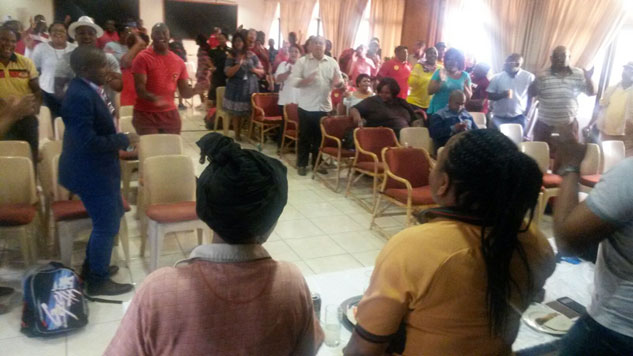
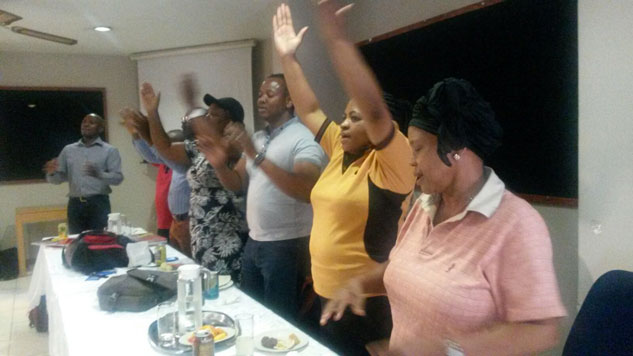
The Democratic Nursing Organisation of South Africa (DENOSA) held its third and last National Executive Committee (NEC) meeting from Wednesday until Friday 20 November, where it deliberated at length on a number of issues pertaining to nursing both politically and professionally.
On #FeesMustFall campaign
We welcome the announcement by President Zuma of a zero percent increase in fees for 2016. As public servants, this decision is also a big relief. We fully support the #FeesMustFall campaign.
DENOSA commended students for steadfastness and being resolute to ensure that no political influence gets involved in the objective call by students.
DENOSA also calls on the Department of Higher Education to ensure equality in education in the country, especially at institutions of higher learning where there are still universities that set up question papers in two languages, English and Afrikaans, which advantages some students in answering them in their first language while others are compelled to answer them in a second language.
As DENOSA we call on nurses to be taken to institutions of higher learning for free for their first undergraduate qualifications. This is in line with policy decisions that were taken by the ruling party at its Mangaung conference.
DENOSA has also taken a decision to critically look at its own bursary system on whether it caters for needy students who want to do nursing and pursue their first undergraduate qualifications.
With the huge shortage of nurses in the country, DENOSA calls on nursing education to be provided for free for student nurses so that the country provides the needed personnel for the country’s health systems.
On security in the country
DENOSA has noted the recent attacks on France. It also noted that the country is at a huge risk. DENOSA is concerned with the invasion of many countries. DENOSA has urged government to ensure safety of the country and its borders.
On new qualifications for nursing
The NEC acknowledged the planned new qualifications that the regulatory body for nursing in South Africa, the South African Nursing Council (SANC), will be introducing in 2018, which is phasing out the lower category nursing (enrolled nurses and enrolled nursing assistance), in favour of staff nurse.
DENOSA is particularly concerned, however, that one of the prerequisites for the staff nurse is that a student should have Computer literacy level 3 (others are Grade 12, English as a compulsory subject and Life sciences).
By far many pupils at secondary schools in the country don’t do computer literacy studies in matric, and this prerequisite will be preventing majority students from disadvantaged communities and schools from entering the nursing profession due to minimum requirements for a staff nurse. Only a few students will benefit and gain access to this qualification, and those will mainly be the ones who enrolled at newly-improved schools, former Model C or private schools.
While there is transformation of nursing mandate by SANC, the reality on the ground is that, due to the increased burden of disease in the country, there is a shortage of nurses which demands a mass production of nurses. The risk with this is that it will cap the production of nurses to an absolute minimum.
On the status of the establishment of nursing directorates in provinces
DENOSA expressed a concern that the status of nursing directorates in provinces leaves a lot to be desired. As DENOSA had championed the call for the establishment of nursing directorates.
In a number of provinces, the nursing directorates have not yet been established, and only directors of nursing have been appointed in some. More disturbingly, there are no structures in place for nursing directorates. When DENOSA called for the establishment of Chief Nursing Officer at both national and provincial levels, it spelled out its ideal organogram, which meant that there will be Chief Nursing Officers in provinces which are adequately staffed and who would work hand in hand with the national Chief Nursing Officer. In the nursing directorates where they exist in some provinces, there is no uniformity that talk to proper governance or reporting control that ensure quality assurance. DENOSA calls for provincial departments that have nursing directorates to copy or mimic the structure of the national Chief Nursing Officer, so that communication of decisions from national office to provincial offices on nursing matters is not misinterpreted before it reaches the implementers on the ground.
The call for the establishment of nursing directorates in provinces is on the basis that nursing matters in the country have for far too long been delegated to different directorates which have little to do with nursing, and cries by nurses on deficiencies and recommendations on how to fix nursing matters fell on deaf ears. There is no synergy in provinces in the reporting lines in provinces. In provinces like the Western Cape, director of nursing reports to the chief director of HR, who has no knowledge or expertise on nursing matters. DENOSA is availing itself to all provincial departments of health for consultation on the establishment of nursing directorates in their provinces.
DENOSA calls on the MECs of Health in provinces to move with speed towards the establishment of fully-fledged nursing directorates in provinces with Chief Nursing Officers heading up those directorates.
On non-absorption of community service nurses
The NEC expressed a great concern about the non-placement of community service nurses (nurses who have finished their four-year studies and are competent and require placement in facilities for a period of one year) in clinical areas in various provinces until now, despite the great need for their service in health facilities. DENOSA finds it absurd that the community service nurses who should have been placed in facilities since January this year are still sitting at home, doing nothing. Previously, DENOSA has made endless calls for provinces to hire the nurses and this call has not been heeded. Therefore, DENOSA demands that community service nurses be placed in facilities across country, and that Health Minister intervenes on this matter.
Placing community service nurses will also address the big challenge of long queues and the speed of service to community members, who tend to turn against nurses when staff shortages is the main cause.
On the call for decentralization of SANC offices and fees
The NEC has noted with great concern the bottlenecking in registration and acquiring of nursing distinguishing devices by nurses, which is taking place at the South African Nursing Council (SANC) offices, the regulatory body for nursing in the country.
In the main, this is caused by the fact that SANC only has one office which is based in Pretoria which administers and renders the above-mentioned services for more than 260 000 people with nursing qualification each year. The absence of SANC offices in provinces has led to the germination of businesses that focuses on helping nurses with queuing at SANC offices in Pretoria at a certain fee. DENOSA believes this should not be happening and the only way to address it is the decentralization of offices to all provinces at least.
Nurses at the DENOSA national congress held in November 2014 agreed unanimously that for this challenge to be resolved speedily, SANC must decentralize it offices to provinces where nurses are. SANC must transform from the apartheid designed system into a 21st Century and people-centered system.
Currently, nurses have to travel long distances to Pretoria to get these, if they are not fortunate to have relatives who are based in Gauteng. Most nurses have to turn back home due to system failure or nursing devices are out of stock.
The NEC also expressed a concern on behalf of nurses on the fee structure that the regulatory body charges and mechanisms used as a justification for the increase. DENOSA appreciates the announcement by the regulatory body, however, to keep the annual fees for 2016 to the 2015 rates.
We call upon SANC to speedily register graduates within 60 days upon completion.
On endless delays in implementation of collective bargaining decisions at provincial level
The NEC noted the disturbing lack of seriousness on the side of the employer in implementing the agreed bargaining outcomes in provincial chambers. On countless occasions, negotiators from government come to negotiations with no mandate from their principals, and as such causing frustration in the whole bargaining chambers.
Interestingly, Western Cape has proven to be the front-runner province in implementing bargaining outcomes at least within a space of six months, followed by Gauteng. Other provinces are not acting in implementing bargaining agreements to such that the employer takes an average of three years before it takes action towards implementing bargaining outcomes. Organised labour has been forced to lodge a dispute against the non-implementation of bargaining agreements due to lack of political will, which undermines the credibility of and essence of collective bargaining.
Both unions and members are losing confidence in the employer. DENOSA cautions that this continuing delay in implementing collective bargaining outcomes will have serious and negative repercussions on the relationship between the employer and organised labour.
On the DENOSA Student Movement National Health Games
The NEC also wished well the organisation’s student movement, DENOSA National Learner Movement, on the National Health Games it will host between 3 and 5 December 2015 at Nelson Mandela Metropolitan University in Port Elizabeth, where they will be encouraging student nurses and communities to embrace well-being.
The games will see 600 student nurses from all nursing colleges and universities in the country participating in the games as health promotion endeavor to fight against non-communicable diseases. DENOSA encourages all South Africans to live a healthy lifestyle, especially during December holidays, and also to do regular exercises.
On achievements for the year
DENOSA is proud to have made great and positive strides this year in the struggle for nurses and nursing profession. These include:
· Hosting a successful International Nurses Day on 12 May where, as the only member organisation of if International Council of Nurses (ICN), we highlighted the years’ theme of: “Care Effective, Cost Effective” which highlighted the need to empower the nursing cadres as it is an essential element that achieves health outcomes for a country.
· Taking part in the ARC meeting together with nursing regulatory bodies and, chief nursing officers and the academia as well as nursing organisations in the African continent on 14 July 2015.
· Participating in ICN Congress in South Korea in June where we raised nursing challenges to the platform, from our regional perspective.
· Attending the Public Services International (PSI), a global federation of public service unions, in Botswana where we highlighted nursing struggles.
· Kick-starting the national recruitment campaign on 19 October 2015 under the theme: Operation Buyelekhaya.
· Awarding the Marilyn Lahana Trust Caring Awards to a deserving, selfless and committed nurse in the country in Pretoria on 20 November 2015 where provincial winners were awarded and national winner is chosen among them.
On winners of the Marilyn Lahana Caring Trust Award
DENOSA congratulates the winners of the annual Marilyn Lahana Caring Trust Awards, awarded to selfless and dedicated nurses in provinces, which were held in Pretoria on Friday 20 November. The awards are named after Marilyn Lahana, a nurse who contracted and succumbed to Ebola in 1996, for her dedication to serve humanity.
The NEC congratulates the following national winners, and encourages all nurses and patients to nominated colleagues or nurses who have shown outstanding dedication to the profession:
· Overall winner - Linda Eustacia Katz – Hulana form Northern Cape (nurse educator at Henrietta Stockdale Nursing College, specialising in Critical Care and HIV/AIDS Care). She got a certificate, a trophy, laptop and a prize money of R10 000.
· First runner-up – Lenah Constance Damelo from Mpumalanga (enrolled nurse from Mkhuhlu Clinic). She got a certificate, a trophy, laptop and a prize money of R7 000.
· Second runner-up – Patricia Mgwexelwa from Gauteng (professional nurse from Nurses-based initiation of the Antiretroviral project). She got a certificate, a trophy, laptop and a prize money of R5 000.
All provincial winners each received a certificate and laptops courtesy of Old Mutual.
On COSATU 12th National Congress
The NEC wishes COSATU a successful 12th National Congress in Midrand from 23 to 26 November 2015.
Furthermore, the NEC fully supports and wishes one of its own national office bearers, and the first from DENOSA since its affiliation to COSATU, cde Oscar Phaka, all the best on his nomination for the position of Deputy General Secretary in COSATU.
End
Issued by the Democratic Nursing Organisation of South Africa (DENOSA)
For more information, contact
Simon Hlungwani, DENOSA President
Mobile: 079 501 4922
Madithapo Masemola, DENOSA Acting General Secretary
Mobile: 082 551 6042
Or
Sibongiseni Delihlazo, DENOSA Communications Manager
Mobile: 079 875 2663
Website: www.denosa.org.za
Facebook: DENOSA National Page
Twitter: @DENOSAORG