View all
Health Minister releases White Paper on NHI
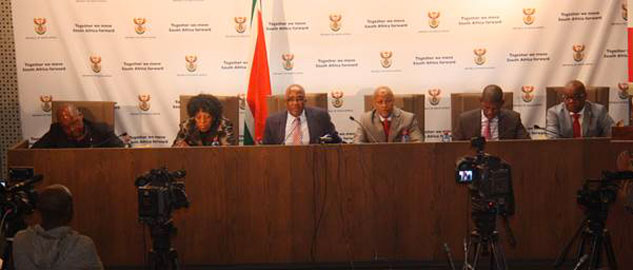
The White Paper on National Health Insurance (NHI) was officially released by Health Health Minister, Dr Aaron Motsoaledi, on 29 June in Pretoria, following its approval by Cabinet on 21 June. It was published in the Government Gazette on 30 June.
He unveiled the White Paper in the presence of Director-General, Dr Precious Matsoso, and four Health MECs from Free State, North West, Northern Cape and KwaZulu-Natal. His gripe is that medical schemes regard health as a condition of employment. “It’s wrong, because our constitution says health is a right.”
Motsoaledi said the policy document was but one step further, and that more steps still needs to be taken by Parliament. He said there must be a National Health Insurance and that all other health-related legislations all need to change to take into account the NHI.
The laws include the National Health Act, Nursing Act, Mental Health Act and many others. As the NHI is a health financing system, Motsoaledi said interim structures will be put in place to come with ideas on how the insurance is to be financed and what benefits it will provide to members.
But he stressed that NHI will do away with the many options that current medical schemes promote, where condition of employment is given a priority than the health need of an individual.
The promulgation of the NHI comes at the back of massive criticism from various quarters, some calling it an ambitious idea that is not affordable.
Motsoaledi said the heartbeat of NHI is primary healthcare: prevention of illnesses and diseases, promotion of health and for patients to rather visit a GP as opposed to a specialist. He stressed upfront that NHI will not agree to pay exorbitant price for medication.
Minister said while the interim team will deal with the funding mechanism, the initial steps that could be taken to take kick-off the funding of the system include interim fund that must benefit from the R20 billion in tax rebates that all medical schemes in South Africa receive from SARS. This in the interim would help with the backlog of primary healthcare service that school-going children, the elderly and pregnant women truly needs at the moment.
He revealed that as part of Schools Health Programme in the pilot district, the Department has discovered many physical barriers to learning for thousands of school-going kids who are in desperate need of spectacles, hearing aids, speech therapy, oral health and others, which 15% of kids have these urgent needs. He said this interim fund could enable each and every pregnant of the total of 1.2 million that get pregnant annually to consult at least 8 times a year.
“We can help with this pooling of funds, and we know that Treasury is going to be helpful,” he said. Motsoaledi said pooling of funds will also save billions of Rands for both beneficiaries and government because the NHI will have the power of pooling funds. Costs per unit for medication and equipment will drastically go down. He made an example of the current exorbitant price for health service between private and public health. For a circumcision procedure, for instance, the cost in private health is R7000 where it is just R800 in public health.
Motsoaledi the interim means of funding NHI must as a first target benefit the more than 34 million South Africans who don’t belong to any medical aid currently. This is the 24 million people who are currently unemployed, and those working in the informal sector plus their dependents.
Minister said the debate on the future existence of medical schemes will be dependent on medical schemes themselves, and whether members see the value-for-money in belonging to two medical schemes.
End


